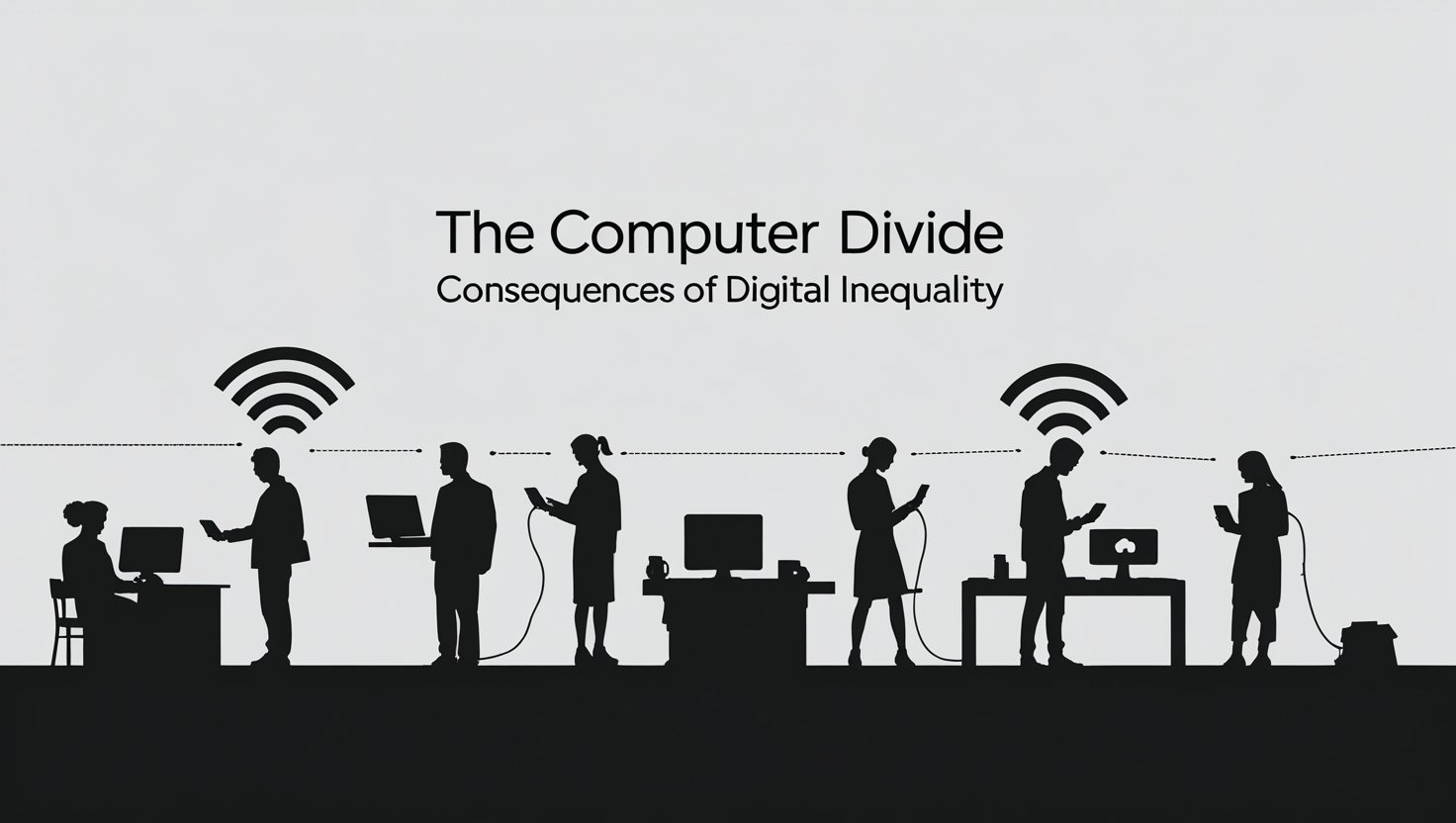
Imagine two neighbors: one streams classes, lands remote work, and telehealth at will, while the other can’t even load a webpage. That gulf is the computer divide, a form of digital inequality that shapes life chances.
Understanding Digital Exclusion:
The digital divide isn’t just a lack of devices or Wi-Fi, it’s a cascade of missed opportunities. Globally, 45.2% of households still lack reliable internet access, creating a hard boundary between connected and disconnected lives. Without stable ICT access, families can’t apply for jobs online, students can’t submit homework, and small businesses can’t tap e-commerce. This exclusion compounds over the years, entrenching disadvantage in ways that physical infrastructure alone can’t remedy.
How Digital Gaps Widen Wealth Disparities:
When access to technology is uneven, entire communities stall economically. Key impacts include:
- Job Market Lock-Out: Many entry-level and remote roles require digital applications and virtual interviews.
- Small Business Strain: Vendors unable to list products online lose customers to digitally savvy competitors.
- Financial Services Shortfall: Mobile banking and fintech apps remain out of reach for those offline, denying them credit and saving tools.
This digital inequality feeds the wealth gap by privileging regions with broadband and leaving rural or low-income areas perpetually behind. Economists warn that nations ignoring this chasm will sacrifice growth and innovation.
Educational Consequences of Unequal Access:
In today’s classrooms, learning doesn’t stop at the school gate, it follows students home via laptops and learning platforms. But when 1 in 2 households lacks internet, homework becomes guesswork, and online collaboration is impossible. Consequences include:
- Lower test scores in under-connected districts.
- Reduced digital literacy, leaving students unprepared for modern careers.
- Widening achievement gaps along socioeconomic lines.
These computer divide effects ripple across generations: once behind, learners struggle to catch up, reinforcing a cycle of educational disadvantage.
Healthcare Delivery and Technology Gaps:
Telemedicine and health-monitoring apps promise universal care, if you can log in. Digital exclusion means:
- Missed virtual consults for chronic ailments.
- Inability to receive real-time updates on local outbreaks.
- Barriers to electronic prescription and lab result portals.
Patients without access face delayed diagnoses and lower treatment adherence. In crises like pandemics, this gap isn’t theoretical, it dictates who survives and who doesn’t. Bridging the digital healthcare divide is now as vital as building clinics.
Political and Social Impacts of Being Offline:
Democracy thrives on engagement, and engagement increasingly happens online. Digital exclusion mutes voices in:
- E-petitions and policy forums.
- Virtual town halls and public comment platforms.
- Fact-checking communities combating misinformation.
When large population segments lack internet access, electoral outreach, public health campaigns, and emergency alerts bypass them entirely. The result is disenfranchisement and weaker social cohesion, undermining both local governance and national unity.
The Unequal Tech Divide for Women and Girls:
Access isn’t uniform across genders. Worldwide, women are 23% less likely to use mobile internet than men; in parts of Asia, Africa, and South America, that gap widens to 30–50%. Cultural norms, cost barriers, and safety concerns keep girls away from digital tools, limiting:
- Online education and STEM pathways
- Women-led entrepreneurship via e-commerce
- Access to health and legal resources hidden behind paywalls. This digital gender gap deepens broader gender inequalities in income, influence, and autonomy.
Infrastructure, Geography, and Policy Failures:
Digital inequality often tracks physical geography. Key factors driving the computer divide:
- Remote terrain that deters broadband investment.
- Urban “digital redlining,” where low-income neighborhoods get slower service.
- High device costs in countries with unstable currencies.
- Weak policy frameworks leave private providers unregulated.
Addressing these requires coordinated infrastructure upgrades, fiber to rural towns, affordable device subsidies, and universal service mandates that hold carriers accountable for coverage equity.
Grassroots Solutions to Digital Inequality:
Top-down policies matter, but local action can move mountains. Successful community initiatives include:
- Pop-up Wi-Fi hotspots at libraries, churches, and markets
- Tech-training hubs where volunteers teach basic digital skills
- Device-refurbishment drives supplying low-cost laptops to families
- Mesh networks built by residents to share limited broadband. By combining digital inclusion efforts with cultural understanding, these grassroots models shorten the gap faster than distant government programs.
Tech Trends That Could Close (or Widen) the Divide:
Emerging technologies offer both hope and risk:
- Low-Earth Orbit Satellites promise global coverage, but at premium costs.
- 5G Networks deliver unprecedented speeds, yet rural rollout lags.
- AI-Driven Learning personalizes education, only if students can sign in.
- Community Internet-of-Things projects extend sensor-based services, but require technical know-how.
If deployed equitably, these innovations can leapfrog legacy barriers; if not, they risk deepening the digital inequality they aim to solve.
Blueprint for Digital Equity:
Closing the computer divide demands a multi-pronged strategy:
- Universal Service Funds that prioritize underserved regions.
- Public-Private Coalitions blending governmental reach with tech-sector agility.
- Digital Literacy Curricula embedded in K–12 and adult education.
- Device Affordability Programs offering sliding-scale pricing or lease options.
- Data-Driven Accountability—regularly published coverage maps and user-experience surveys. When policymakers, businesses, and communities unite around digital equity, the gulf between plugged-in and left-behind can finally shrink.
Conclusion:
The computer divide isn’t a distant policy issue, it’s a lived reality for billions, shaping education, health, economy, and democracy. By recognizing its multifaceted consequences and championing both innovative technology and grassroots action, we can rewire societies toward true digital inclusion.
FAQs:
1. What defines the digital divide?
The gap between those with reliable ICT access and those without.
2. How many households lack internet globally?
About 45.2% of households worldwide remain unconnected.
3. Why is digital access vital for education?
It enables homework submission, online resources, and virtual collaboration.
4. How does digital inequality affect health?
It blocks telemedicine, remote monitoring, and timely public‐health alerts.
5. Can grassroots efforts bridge the gap?
Yes—local Wi-Fi hotspots and tech-training hubs reduce exclusion.
6. What policy helps ensure device affordability?
Subsidized lease programs and sliding-scale pricing for low-income users.